HMT Lancastria 'The Forgotten Tragedy'

Polite Notice:


IMPORTANT NOTICE

The book 'The Forgotten Tragedy' is officially 'out of print' but, occasionally, an odd copy does appear! When this happens an updated Addendum List is added to bring the book up to date. However, copies of the 64-page 'Book of Remembrance. HMT Lancastria' are still available directly from the author (the only source). This too has a Roll of Honour and, if the superscripted acronym N/A appears beside the casualty's details, it tells the reader that the author has some documentation from The National Archives at Kew concerning their loss.


To purchase a copy of this beautiful little book entitled: 'Book of Remembrance. HMT Lancastria.' Simply email the following address:


bustercrabb548@gmail.com


List of Contents:


Letters

Book Reviews

Note: The Roll of Honour and the List of Survivors has had to be removed from this website because of its size. I am really sorry that this has happened, but when the list exceeds 4,000 names with a lot of detail it does take up a great amount of space.


Email sent by Brian Evans on 19 September 2019

(Brian's father's brother Private David Emelyn Evans (21) 2 Field Bakery RASC

No. T/98705 was a casualty of HMT Lancastria and is buried in Pornic War Cemetery, France.


To all of affected by this emotional tragedy, I believe there are not enough accolades for what Brian Crabb has done for us. To me it's an honour and privilege to own this book (The Forgotten Tragedy) and I shall never stop talking about HMT Lancastria for the rest of my life. Thank you Brian Crabb from the bottom of my heart.


Email sent by Maria Curran on 27 January 2019

(Maria's Great Uncle William John Coats was lost in HMT Lancastria)


Hi Brian


I have received my book (The Forgotten Tragedy). Thank you so so much.


I read your dedication and it's so beautiful. But also so sad. My Nana never mentioned anything, but she lost her brother. Seeing your words he was washed ashore was painful. But in my own way I believe the tide carried him back to land for a reason. Not to be lost without a resting place. (He is buried in St Denis-d'Oleron communal cemetery on the island of Oleron in France).


I'm looking forward to reading the entire story. 

Thank you for your time putting together this story to set the story straight. 

I've just attached two photographs. Close up of William John and with his family. He originated from Barnstaple in Devon. My Nana had relocated to Liverpool after her mother's death in 1933.


Again my sincere thanks

Kind regards

Maria


The Forgotten Tragedy


The Story of the Sinking of HMT Lancastria


The Review - Spring 2002 Volume 14.4


(A Quarterly Journal of the Naval Historical Collectors & Research Association)


A third book from Brian Crabb and his best to date. Many people know of this disaster, the worst in British maritime history, but others will be quite unaware of this tragedy. It has not received a huge amount of publicity nor has it featured in films with glamorous stars and attracted a cult following. There are no exact figures for the number of persons on board or for those who died when the ship was sunk, on 17 June 1940, off the port of Saint-Nazaire. The author has spent four daunting years gathering material for the book. He is to be congratulated on his perseverance in assembling all the details that make up this work, such as the 103 pages of Appendices which accompany the eleven chapters.

The book begins with details of how the the public eventually learned of the loss of HMT Lancastria, news of her sinking having been withheld on the orders of Winston Churchill. The narrative then reverts to the building of the ship and her pre-war history with full details of her construction; so that the reader can appreciate better the conditions on board when the ship was over-full of service personnel and some 200 refugees.

The early war employment of the ship is given in detail. Then the scene is set for Operation Aerial, the evacuation of the British Expeditionary Forces from north-west France, building up to the final days. Chapter III takes an interesting look into German archives for the background history of KG 30, the Luftwaffe unit equipped with Junkers 88 bombers especially trained in the art of attacking ships. These were the aircraft and men responsible for sinking the Lancastria. From here the narrative is enlivened with first-hand accounts by survivors, many of whom the author met having made contact with 'The HMT Lancastria Association'. These accounts make very harrowing reading and build up a picture of what conditions were like on that awful day.

To complete his varied research the author attended the 60th Anniversary of the sinking and visited some of the Commonwealth War Graves Memorials and Cemeteries. The latter bring me to the figures for the number of persons who boarded this ill-fated ship and lost their lives. Widely differing numbers have been quoted. It is impossible to produce a definitive list but Brian Crabb has done his best and gives a careful explanation for the composition of the various lists. These record all known and likely names together as a memorial to those who died that day almost 62 years ago. A book well worth having in your bookcase, both for reading and reference.


Review by [the late] Richard Cornish  


The Forgotten Tragedy

The Story of the Sinking of HMT
Lancastria

by Brian James Crabb

This book records the tragic story of the sinking of the troopship
Lancastria, which was bombed and sunk by Junkers 88 bombers in the estuary of the River Loire, on Monday, 17 June 1940. Crammed with approximately 6,000 troops, RAF personnel, civilians and crew, a third of whom did not survive, this incident remains Britain's worst-ever maritime disaster but, like many other shipping disasters of the Second World War, it remains little known today.
   Following the successful evacuation of Dunkirk only weeks before, Winston Churchill initially forbade media disclosure of the event. Over a month passed before the story eventually reached the national newspapers, via American journalists. This first in-depth study of the incident draws on many eye-witness accounts and previously unpublished papers, and includes 90 illustrations and many appendices, the first of which is a 40-page list of the names of all the men known to have been lost with the ship. The book presents pioneer research which, in addition to recording the true sequence of events in detail, attempts to establish for the first time a reliable figure of how many were lost on that day.

It has long been claimed that as many as five thousand men were lost, but Brian Crabb's research has established that the true figure is closer 2,000. Nevertheless,
Lancastria's position as Britain's worst disaster remains unchallenged.
   The book is a large-format hardback of 293 pages, printed on quality paper and is beautifully illustrated with plans and photographs, including many of the actual sinking and rescue.
   
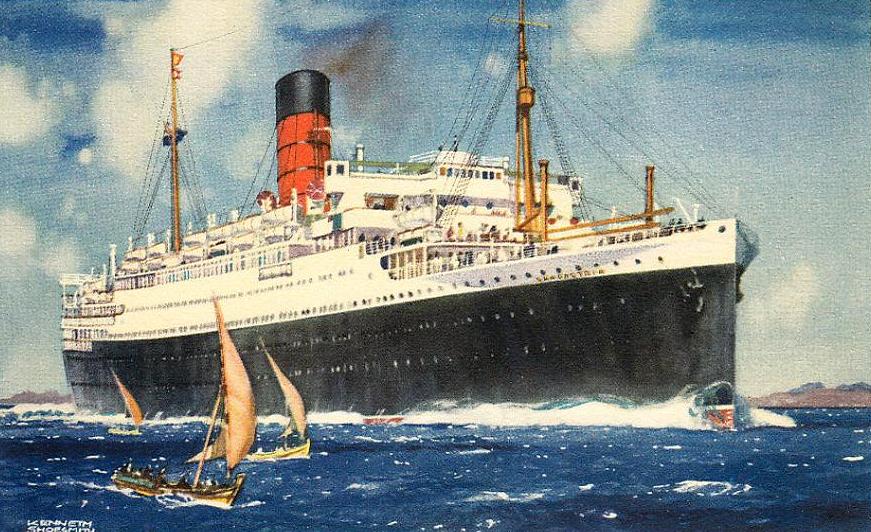
Lancastria was a Cunard liner, sister to Cameronia, and both built by William Beardmore and Company of Dalmuir, Glasgow, in 1919-20. First named Tyrrhenia, she was renamed Lancastria in 1924, and requisitioned by the Ministry of War Transport as a troopship in late 1939.
   This publication completes a trilogy of titles published by Shaun Tyas (Paul Watkins Publishing) commemorating and restoring to public attention the first-, second- and third-worst Allied mercantile disasters of the Second World War (the loss of the steamships
Lancastria, Laconia and Khedive Ismail in 1940, 1942 and 1944). A terrible coincidence links the first- and second-worst disasters, for most of Lancastria's surviving crew and captain (Rudolph Sharp) transferred to Laconia shortly after their rescue, thus some taking part in the two most notorious Allied mercantile losses in the war.

The Forgotten Tragedy

The Story of the Sinking of HMT
Lancastria

by Brian James Crabb

Review by John Armstrong
Thames Valley University, London
JMR, National Maritime Museum, Journal Issue: April 2003

This well-illustrated volume is not aimed at an academic readership but rather at the survivors of this tragedy, their families and friends, and the relations of the many who perished when this liner was sunk. Thus it is a form of memorial to that loss and a labour of love on the part of the author, who had no direct or indirect involvement in the incident, but became determined to tell the story of the disaster.
   The story is soon told. In June 1940, as part of the withdrawal from France in the face of the invading German army, the Cunard White Star liner,
Lancastria was sent to Charpentier Roads, just outside the port of Saint-Nazaire, to embark soldiers and airmen and bring them back to Britain. While anchored there and virtually fully laden with troops a German Ju88 bomber scored several hits on the Lancastria, including one bomb down the funnel and a couple in the holds. As a result the liner rolled over onto her port side and sank in about twenty minutes. The precise number who died cannot be known. The ship was carrying about 6000 people and at least 2000 are known to have perished, but given the circumstances accuracy is impossible. What is certain is that this incident rates as the worst ever maritime disaster to take place to a British merchant ship in the Second World War, indeed 'the worst disaster in Britain's maritime history'.
   This tragedy has never been written up properly and Crabb's book although not the first volume devoted to this topic is the most comprehensive. It is a combination of narrative from the author and statements from the survivors, some of which have appeared in print before, but this is the first time that all the data has been gathered together in one place. The book, as befits a tribute to the memory of heroism and courage as well as disaster, has a roll of honour of all those who are known to have lost their lives in the calamity, a listing of all honours awarded as a result of the incident, the captain's career details, newspaper reports, and even a menu of the lunch that day, which seems quite out of place. There is an impressive bibliography of both manuscript sources from the PRO (now called The National Archives), Guildhall Library and other sources, and also a list of relevant published works. There are full picture credits, but no referencing system to show where the quotes and precis come from, which detracts from its academic value.
   The book is very successful, in that it achieves what it set out to do, namely to provide in one volume all that is recorded and remembered about this terrible loss. Its target audience should be pleased with its comprehensiveness, sensitivity, and attention to detail. It is a fitting memorial to those who lost their lives and testimony to the acts of bravery, defiance and endurance which occurred. The eye-witness and participant statements give the text an immediacy and vividness.
   It is also important to stress that although this was the worst disaster to occur to a British merchant ship in the Second World War, it was not the worst of the war. That unhappy distinction goes to a number of German ships which were sunk in 1945, sustaining casualty figures two or three times those of the
Lancastria. These tragedies included the loss of the Goya, Cap Arcona and Wilhelm Gustloff. Crabb acknowledges these in an appendix but it might have been stressed in the text itself. It, of course, in no way lessens the tragedy, but puts this case study in a wider context.
   Are there other wider lessons to be learnt from this event? The glaring one is how vulnerable ships were to air attack and how essential it was to have air cover. The second is the need for easily launched rafts and adequate numbers of life-belts or jackets and the third was the danger involved with carrying large quantities of fuel oil. Nothing could be done about any of these in the short run and, given the speed and magnitude of the German attack, risks were taken to bring the British troops home.

© NMM London

Book details: 293 pages, 87 illustrations


ISBN: 1-900289-50-4

JMR, National Maritime Museum, Greenwich, London SE10 9NF
Email: jmr@nmm.ac.uk; tel: +44 (0) 20 8312 6648

__________________________________________________________

The Forgotten Tragedy

Book Review published in the Royal Engineer's magazine
The Sapper in March 2003:

Brian Crabb's new book is not a work to be compared with others written on the subject. It is less 'emotional' writing, with a difference to that of Geoffrey Bond and John West. He has composed his work from scratch and carried out extensive research.
   It does include survivors and other eyewitnesses' narratives, some of them published for the first time. They differ in as much that they include interviews and the author has been able to probe and obtain what he needed. Brian's experience gained in researching his other naval histories and his connection in maritime affairs has enabled him to approach the subject in a planned and objective manner. His participation in the 2000
Lancastria Association's pilgrimage provided him with valuable material and he has doubtless gained from the bond he formed with many of the survivors he met and interviewed.
   For survivors, the book will bring to the fore the many records and official files which exist and are only now being released. No doubt some will take issue over the omissions, but official documents have been reproduced unaltered. All this will add to the continued
Lancastria 'debate'.
   For relatives and loved ones, I consider that the book will better understand the massive force which was impacted upon the servicemen and civilians before, during and after the attack. Even their children, some born posthumously, were effected for the rest of their lives.
   All books containing 'facts' are subject to errors. The few insignificant errors in Brian's book are mainly due to assumptions being made, particularly when information provided by others is incorrectly listed. Considering the age and condition of some references, the errors are excusable and easily corrected. He has through his merchant naval knowledge, also cleared up misconceptions that have existed since the day of the sinking.
   It should be said that when Brian Crabb first announced his intention to write this book, the reaction was sceptical. His critics, myself included, have been confounded and he is to be congratulated for his dedication and scholarship.

Brian Reynolds
(ex-President of the disbanded
Lancastria Association)

Webmaster Review:


Brian Crabb's book will undoubtedly prove to be the seminal and definitive story of the sinking of the
Lancastria. The research and work which Brian has put into this book can be seen on every page. The Forgotten Tragedy tells the full story of the Lancastria and is the perfect starting point for anyone wishing to know all of the aspects to this horrific disaster. As a historical resource it is truly immeasurable and contains for the first time a full list of all those victims known to have been lost on board Lancastria on 17 June 1940.

If you only ever read one book about the Lancastria, make sure you read this one. 


Mark Hirst